Tom Polhaus
The Maltese FalconTom Polhaus is a San Francisco police detective who serves as a recurring link between the police investigation and Sam Spade’s private inquiry. Often accompanying Lieutenant Dundy, he brings a less confrontational manner to their dealings with Spade, though he remains part of the department pursuing the case. His role culminates when Spade gives him the names and whereabouts of the people behind the murders, and Polhaus reports that they have been caught.
Identity and First Appearance
At the scene where Miles Archer’s body has been found below a broken fence, Polhaus approaches Spade from the slope. He is described as tall and barrel-bellied, with small, shrewd eyes and a thick mouth; his shoes, knees, hands, and chin are marked with soil from the search. He explains that he wanted Spade to see the body before it was removed, indicating recognition of Spade’s professional connection to the dead detective.
Polhaus shows Spade the mud-marked revolver found in the case and identifies it as a Webley. Spade specifies that it is a .38, eight-shot Webley-Fosbery automatic revolver, and asks how many rounds have been fired. Polhaus’s presence at the scene places him among the officers gathering physical evidence, while his willingness to consult Spade acknowledges the private detective’s expertise without making him a police subordinate.
Police Inquiries and Tension with Spade
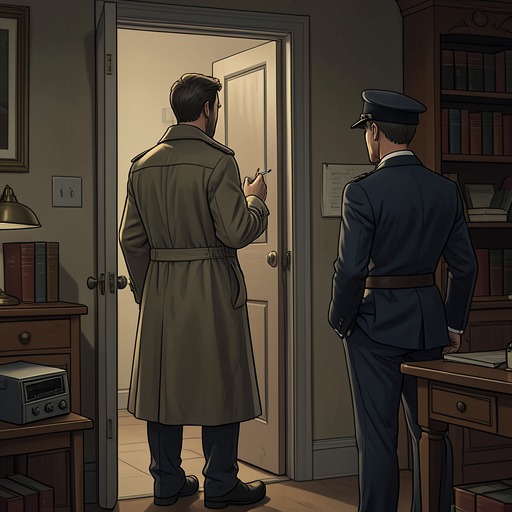
Polhaus later arrives at Spade’s apartment with Lieutenant Dundy. The two detectives question Spade in connection with the killings, and Dundy presses him for information about his client. Spade refuses to identify the client before discussing the matter with that person. Polhaus protests when Spade invites the officers to search his apartment only if they have a warrant, and Dundy’s more openly adversarial approach sets the tone for the encounter.
When Dundy strikes Spade during another confrontation, Polhaus immediately places himself between the two men, physically obstructing Spade from retaliating. He pleads with Spade to stop, and Spade eventually relaxes and tells him to get Dundy out of the room. The intervention does not dissolve the hostility between Spade and the police, but it shows Polhaus trying to prevent their dispute from escalating into further violence.
The recurring visits become a source of irritation for Spade, who complains about the officers’ early-morning questions. Polhaus answers that the detectives have work to do, even though they do not like the situation any more than Spade does. He recognizes the strain of the investigation while standing by the department’s obligation to pursue it.
Working Relationship with Spade
Polhaus and Spade’s relationship is not simply one of interrogation. At a later meeting over pickled pigs’ feet at the States Hof Brau, Polhaus asks Spade to forget the earlier confrontation with Dundy. He concedes that Dundy was wrong but argues that anyone might lose control under the pressure of Spade’s provocations. The apology is informal and qualified: Polhaus seeks to repair the personal breach without denying the department’s continuing investigation.
In that conversation, Polhaus says that Dundy did not believe Spade had shot Miles, though he had to follow the lead. Spade responds by challenging Polhaus to explain why he himself is so sure Spade is innocent. Polhaus answers that Thursby shot Miles; Spade pointedly distinguishes that assertion from proof, replying that Polhaus thinks this is what happened. The exchange reveals both a measure of trust and the limits of it: Polhaus offers his interpretation, but Spade will not treat a police officer’s belief as established fact.
Polhaus also shares the department’s attempt to question a suspect described by Spade as a lily-of-the-valley. He says the officers worked on the man for less than two hours, saw they were getting nowhere, and let him go. Spade mocks the brief failure, but the detail shows Polhaus speaking candidly about a line of inquiry that has not produced a result. Their conversation ends with Spade saying he has an appointment with the district attorney that afternoon, another indication that Polhaus is one of the channels through which the investigation’s changing progress is discussed.
The Investigation’s Resolution
Spade’s final telephone call makes Polhaus the recipient of decisive information. Spade asks for Sergeant Polhaus and identifies himself as Samuel Spade. He reports that Thursby and Captain Jacobi were shot by Wilmer Cook, describes Wilmer and Casper Gutman, identifies Joel Cairo as involved, and gives Gutman’s Alexandria Hotel suite as a location from which the group has just departed. He also warns that Wilmer is believed to be dangerous with a gun and says he has the weapons he thinks were used.
The call converts Spade’s private investigation into actionable information for the police. He urges Polhaus to move quickly because the suspects are leaving town, then wishes him luck. When Lieutenant Dundy, Polhaus, and two other detectives arrive at Spade’s door, Spade asks whether they got the suspects. Polhaus answers that they did. His brief confirmation closes the practical arc of their relationship: the detective who first appeared at the murder scene with evidence is again present when the police operation succeeds.
Character and Narrative Function
Polhaus is a supporting figure, but his repeated appearances give the police investigation a human presence distinct from Dundy’s sharper clashes with Spade. He participates in questioning and evidence-gathering, yet also mediates conflict, acknowledges professional pressure, and attempts to restore a workable personal relationship after the confrontation. These qualities do not make him an opponent of the investigation; rather, they distinguish his manner from the more combative methods used by his colleague.
His role also clarifies the uneasy boundary between private detective work and police authority. Spade insists on controlling information about his client and on presenting a viable suspect when the reckoning comes; the police must investigate leads and act through their own procedures. Polhaus stands at the point where those tracks meet. Spade’s eventual call gives the police names, descriptions, a location, and a warning, while Polhaus’s closing reply confirms that the information has led to arrests.